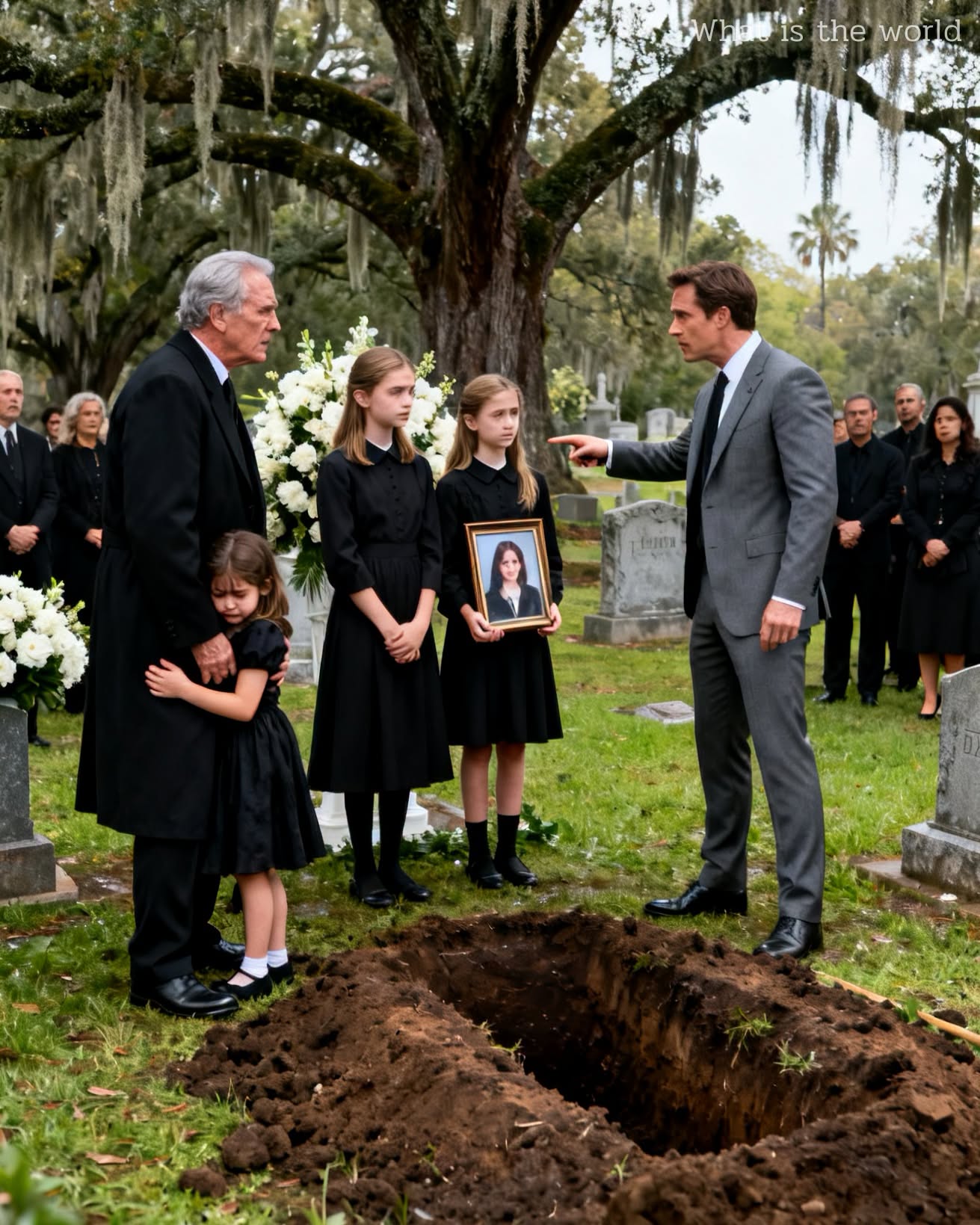
Then Lucy knocked softly on the door.
“Grandpa?”
I opened it.
She searched my face, and I realized she was not asking what I had heard.
She was asking whether the truth had made me want them less.
I pulled her into my arms.
“You three are staying together,” I told her. “Nothing in that box changes that.”
Her shoulders dropped for the first time since the cemetery.
That night, the girls slept in Rose’s old bedroom and the guest room, with every light in the hallway turned on.
April woke twice calling for her mother.
Rachel refused to take off her black shoes because Rose had buckled them for her before her final hospital stay.
Lucy placed the framed photograph on the nightstand but kept the empty brass key beneath her pillow.
The next morning, I contacted a family attorney and explained only the immediate facts.
Arthur had publicly refused responsibility for his daughters, threatened to send them to Child Protective Services on Monday, and left them with me without medicine, clothing instructions, or a plan for their care.
The attorney did not promise me a permanent outcome.
She told me to preserve the notebook and recordings, write down what I had personally witnessed, and gather names of people who had heard Arthur at the cemetery.
By noon, relatives were calling.
Some wanted to know whether Arthur had truly meant what he said.
Others urged me to avoid a family scandal so soon after Rose’s funeral.
One cousin suggested grief might have caused Arthur to speak carelessly.
I asked whether grief had also made him arrange for his fiancée to wait in a van outside his wife’s burial.
The cousin had no answer.
I did not post the recordings or send them through the family.
Rose had been clear.
The truth was supposed to protect the girls first.
A child welfare worker met with us that afternoon after Arthur followed through on his threat and reported that the children had been taken by an interfering relative.
His version collapsed quickly under the simplest questions.
He had no message asking me to keep them temporarily.
He had packed none of their belongings.
He had not called once to check whether April had her inhaler, whether Rachel had eaten, or whether Lucy understood where she would attend school.
The worker spoke to each girl separately.
I did not hear what they said, but Lucy emerged holding the framed photograph against her chest again.
Arthur arrived at my house before sunset.