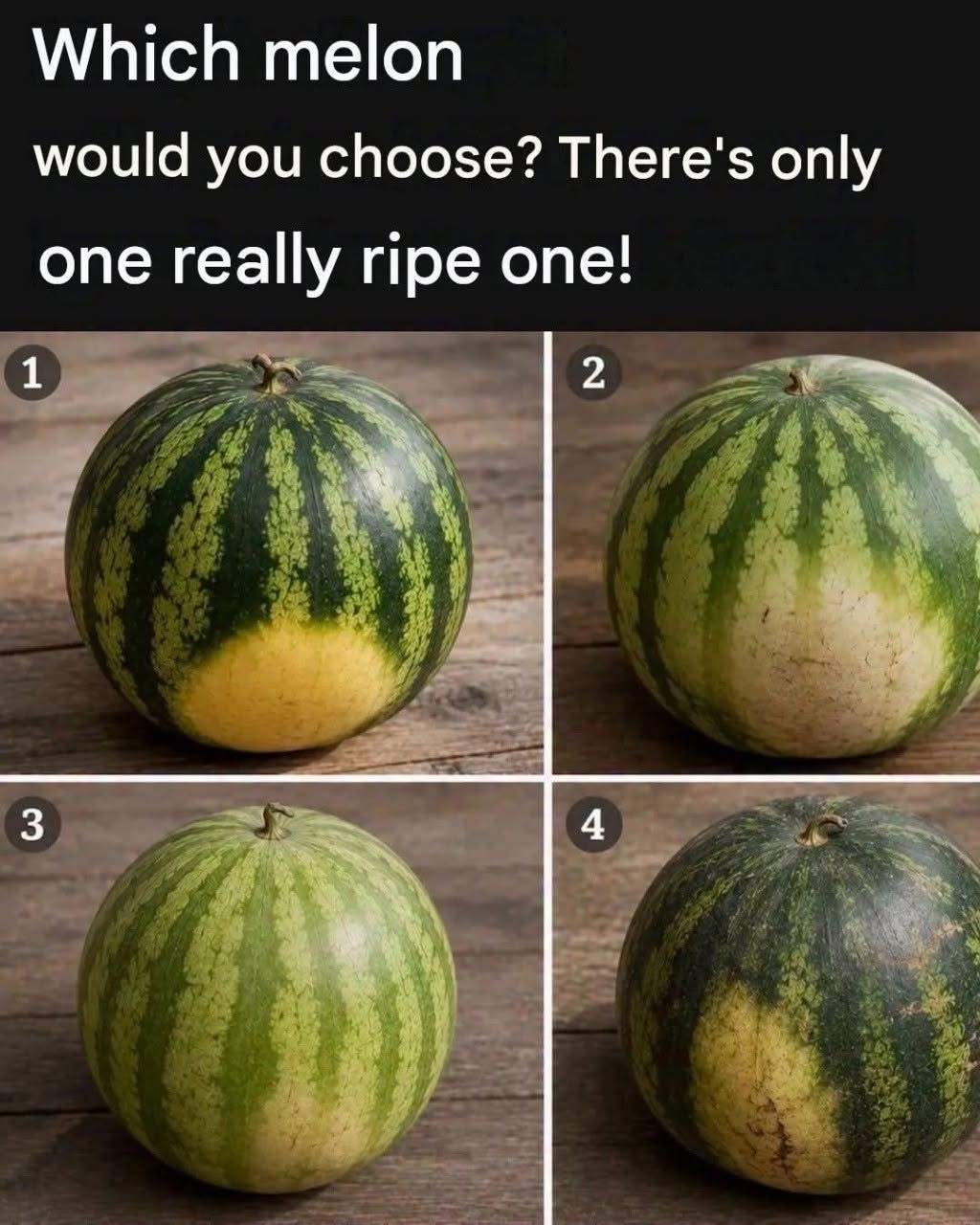
Melon 2
The second melon has a very large ground spot and is more light than creamy yellow. Its skin is not as nice either, it is slightly paler, which may indicate that it has not yet reached the perfect level of ripeness. This may still make it edible, but the flavor will probably be less intense than that of melon 1.
If you come across a melon like this in the store, it is worth checking to see if there is a better specimen next to it. It’s not a bad choice, but it certainly wouldn’t be the first of the four.
Melon 3
The third melon has a lighter skin, less vibrant stripes than the others, and a less intense yellow ground patch. These signs often indicate that the melon is still a bit immature. In such cases, the inside may be less sweet and crunchy, so it’s best to skip them.
It’s not necessarily a bad fruit, but it probably won’t offer the flavor you expect from a really good watermelon. If there’s another option, it’s better to choose it in stores.
Melon 4
The fourth melon is dark in color, but there are already several small bruises and brown spots on the skin. These don’t mean that the inside is bad, but they are a sign that the quality is not the best. The surface is less uniform than the first melon.
If that’s all it was, it could still be good, but the damage means there’s a higher chance it won’t be perfect inside either. The safe choice is still the No. 1 melon, which best matches the characteristics of a ripe watermelon.